Table of Contents
Green Roof
Green roofs are a roofing systems with a layer of vegetation planted over the waterproofing system that is installed on top of a flat or slightly sloped roof. Water is stored by the roof's substrate and then taken up by the plants, returning to the atmosphere through evapotranspiration.
Green roofs can be an effective stormwater management practice employed over a wide range of applications but are most commonly used on mid- to large-sized structures in dense urban settings where the potential for at-grade stormwater management is limited due to tight or contaminated soils, shallow bedrock, high groundwater, or space constraints. They've also been shown to provide significant social, economic, and environmental benefits, particularly in areas where green space is limited. The selection of which type of green roof to use should consider stormwater management benefits, climate, building parameters, maintenance requirements, intended use as an amenity space, as well as the long-term economics of installation and maintenance versus associated benefits.
Advantages
- Reduces runoff volume through increased evapotranspiration
- Slows rate of runoff
- Mitigates thermal impacts of runoff
- Extends life of roof membrane
- Creates habitat and beautifies the built environment
Disadvantages
- Heavier than traditional roof, requiring additional support
- Increased cost and maintenance compared to traditional roof
Design
There are many types of green roofs, which can be categorized based on the type of assembly and system components. The primary types of systems are:
- Extensive
- Shallow growing medium (<6“), with a modest roof load, limited plant diversity, and minimal watering requirements.
- Intensive
- Minimum twelve-inch thick growing medium, which can support a more diverse plant selection, including small trees.
- Semi-intensive
- Modular (tray) systems
- Layered systems
- Enhanced systems
- Sponge roof (additional retention in mineral wool or synthetic fabric)
- Blue-green roof (sponge + detention storage)
- Purple roof (sponge + detention storage + friction layer)
Any of these systems can be used to meet stormwater requirements, but must be designed to address the following elements.
Drainage Area
A green roof generally manages precipitation that falls directly on it and from adjacent walkways, patios, etc. Green roofs are generally not designed to handle significant runoff from other surfaces and should not be designed to accept runoff from impervious surfaces greater than the area of the green roof surface.
Roof Slope
The slope of a green roof impacts the detention volume and flow of water through the drainage layer. Increased slope can cause the green roof system to drain faster and should be a consideration in runoff management, plant selection and time of concentration. Slopes steeper than 2:12 pitch may need specialized reinforcement to protect the green roof system from sliding.
Vegetation
Vegetation can be established using plant plugs, cuttings, seed, pre-grown mats, or pre-vegetated modules. Each green roof is unique in its project goals, growing conditions, climate and micro-climate considerations, and maintenance requirements. The designer shall take all these into account when designing a green roof system for successful vegetation establishment and maintenance.
- Choose plant species that are adapted to the soil and moisture conditions. The depth and composition of the growing media may limit the plant species that can thrive. Sedums are often chosen for extensive systems because they have shallow root systems and are adapted to conserve water. Intensive systems with deeper media depths can accommodate a larger variety of plants.
- Native species are preferred, but the designer should choose plants that have the greatest chance to successfully establish.
- The nutrient needs of the plants shall match that available in the growing media; care shall be taken that excess nutrients are not leaching out of the system.
- Select species based on the local climate and the building micro-climates. Wind, temperature, sunlight, and rainfall (climate) all impact plant growth on green roofs; and those factors can vary in different areas of the roof (micro-climate), especially around the edges. Be aware of extreme conditions caused by edge effects, prevailing wind patterns, variable sunlight conditions, exhaust fans, and reflections from adjacent windows or siding. Consider no-planting zones as appropriate.
- Planting should be avoided during the peak summer months due to the additional irrigation required.
Resources for choosing green roof vegetation are provided in Appendix 2 of the Green Roof Guidance Document.
System Layer Requirements
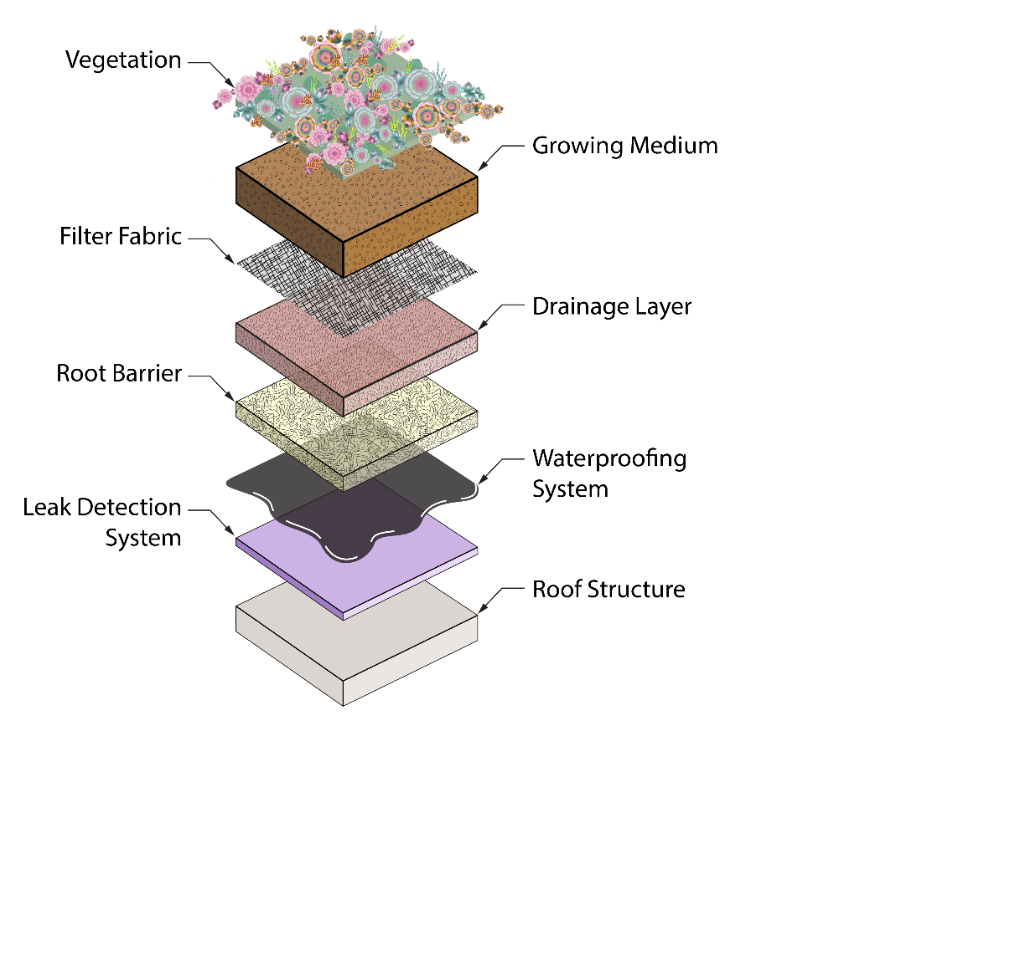
There are several types of green roof systems with variations in their system components and characteristics, but in general, most green roofs have the following layers or components beneath their vegetation:
- Growing Media - Provides the structure and nutrients for plant growth, allows rainfall to permeate into lower layers of the green roof system, and holds some of the runoff for later evapotranspiration from the surface. Also provides additional heat and noise insulation for the building. A lightweight, engineered aggregate is usually chosen to reduce roof loading. Mixes are generally 80-90% lightweight aggregate and 10-20% organic matter. Permeability must be at least 1 inch per hour.
- Filter Fabric - This layer is installed directly under the growing media to prevent fines from migrating into the lower layers of the green roof system. Any filter fabric used for this purpose must be strong enough to support the weight of the growing media and vegetation. Roots are permitted to penetrate this layer.
- Drainage Layer - Design determines how much water is stored within the green roof system and how quickly water leaves the system. This layer can serve as retention or detention depending on the design requirements and can be designed to hold water for later use by plants. For example, it may contain voids for water storage or a high-storage-capacity (sponge) layer.
- Root Barrier - Protects roof (i.e., waterproofing membrane) from damage by plant roots. May not be needed if the waterproofing membrane is root resistant. Can be incorporated into the drainage layer.
- Waterproofing System - Protects the roof material from moisture and leaks under the green roof.
- Leak Detection System - A leak detection system is recommended and shall be configured to identify the location of leaks within the green roof system. Leak detection systems shall be installed and used in accordance with manufacturer’s specifications.
Drains
Allows unconsumed water to exit the roof. Drains that direct excess water off the roof should be kept free of vegetation and other organic matter to improve flow and reduce the risk of clogging. In order to avoid potential erosion that may result from the concentration of flow on the rooftop, drains should be located on the roof so that the maximum flow length is 100 feet.
Irrigation
Irrigation, or the ability to irrigate when needed, is strongly recommended for all green roof systems. Irrigation is an important design parameter and considerations should be made during the early design phases to accommodate this component. Irrigation is required during plant establishment and during long durations without rainfall. Moisture meters can be installed and used to determine when irrigation is necessary.
Equipment & Storage
Green roofs require regular maintenance. Space should be allocated for the needed equipment storage. The design should provide appropriate storage and access (e.g., garbage shoot) for collecting and disposing of plant and other debris for maintenance activities.
Erosion Control
An erosion control plan shall be implemented to prevent erosion from exposed soils due to wind and rain during vegetation establishment.
Safety
Incorporate long-term safety measures into the design for both the installers and the maintenance workers. Provide easy roof access and protection systems including, but not limited to: safety ladders, walkways, internal hatches, fall restraint or fall arrest systems, tie-offs, anchor points, lifelines, guard rails, and knee walls. Consider not planting vegetation near the edge of the roof. Ensure workers doing maintenance in elevated environments have proper training and personal protective equipment.
Maintenance
- Inspect twice a week during vegetation establishment and at least once every season after that, as well as after every storm even exceeding 1” or major weather events.
- Strongly advise using a landscaping professional to inspect vegetation and keep coverage above 80% to prevent the spread of weeds.
- Replace media and vegetation if standing water for >72 hours.
- Include access and safety recommendations for inspector and maintenance workers.
- Provide recommendations for watering
Method to Determine Practice Efficiency
No credit shall be granted for Total Suspended Solids (TSS) or Total Phosphorus (TP) reduction for water passing through or over a green roof system; however, reduction on a site-wide basis can be realized through a reduced overall volume of stormwater due to retention in the green roof.
Adjusted Curve Number
Peak rate and volume calculations should follow the steps below to determine an adjusted curve number for use in hydrology calculations. Volume reduction on a green roof is achieved primarily through the drainage layer and growing medium components, which absorb and retain a portion of the rainfall that lands on it making it available for plant uptake and evapotranspiration.
For the calculation of runoff retention in the growing medium, the maximum available water capacity for runoff reduction, or 𝜂1, is the difference in the water content between the field capacity and the wilting point.
- Field capacity is the water content of the soil after free drainage has ceased.
- Wilting point is the minimum soil moisture required by a plant to not wilt.
Values for field capacity and the wilting point of the selected growing medium must be obtained either from a published research article or tested in accordance with either the ASTM D-6836 method or the Soil Survey Investigations Report No. 42, Kellogg Soil Survey Laboratory Methods Manual, published by NRCS.
The following calculation, adapted from the New Jersey Stormwater Best Management Practices Manual, can be used to determine the adjusted curve number which can then be used in approved hydrology models to determine the reduction in runoff peak rates and volume provided by a green roof.
Step 1 - Calculate storage volume of green roof
$$ V_s=\frac{A_\text{roof} \cdot[(d_\text{media} \cdot 𝜂_1)+(d_\text{drainage} \cdot 𝜂_2)]}{12 \frac{in}{ft}} \quad , where: $$ $$ V_s=\text{storage volume (cf)} $$ $$ A_\text{roof}=\text{green roof area (sf)} $$ $$ d_\text{media}=\text{media depth (in)} $$ $$ 𝜂_1=\text{available water capacity for runoff retention} $$ $$ d_\text{drainage}=\text{drainage layer depth (in)} $$ $$ 𝜂_2=\text{drainage layer field capacity} $$
Step 2 - Calculate runoff volume
Calculate the runoff from a traditional roof (CN=98) of equivalent area and subtract the storage volume from Step 1 to determine the green roof's runoff volume. Perform this calculation for each design storm to determine the corresponding roof runoff volumes.
$$ \text{Green Roof Runoff (cf) = Traditional Roof Runoff (cf)} - V_s $$
Step 3 - Calculate direct runoff depth
Divide the green roof runoff volume from Step 2 by the green roof area to determine the direct runoff depth.
$$ Q=\frac{\text{Green Roof Runoff (cf)} \cdot 12\,(\frac{in}{ft})}{\text{Green Roof Area (sf)}} \quad , where: $$ $$ Q=\text{direct runoff depth (in)} $$
Step 4 - Determine adjusted curve number
Use the direct runoff, 𝑄, calculated in Step 3 and the rainfall precipitation, P, for each of the storm events to find the corresponding curve number from the figure below.
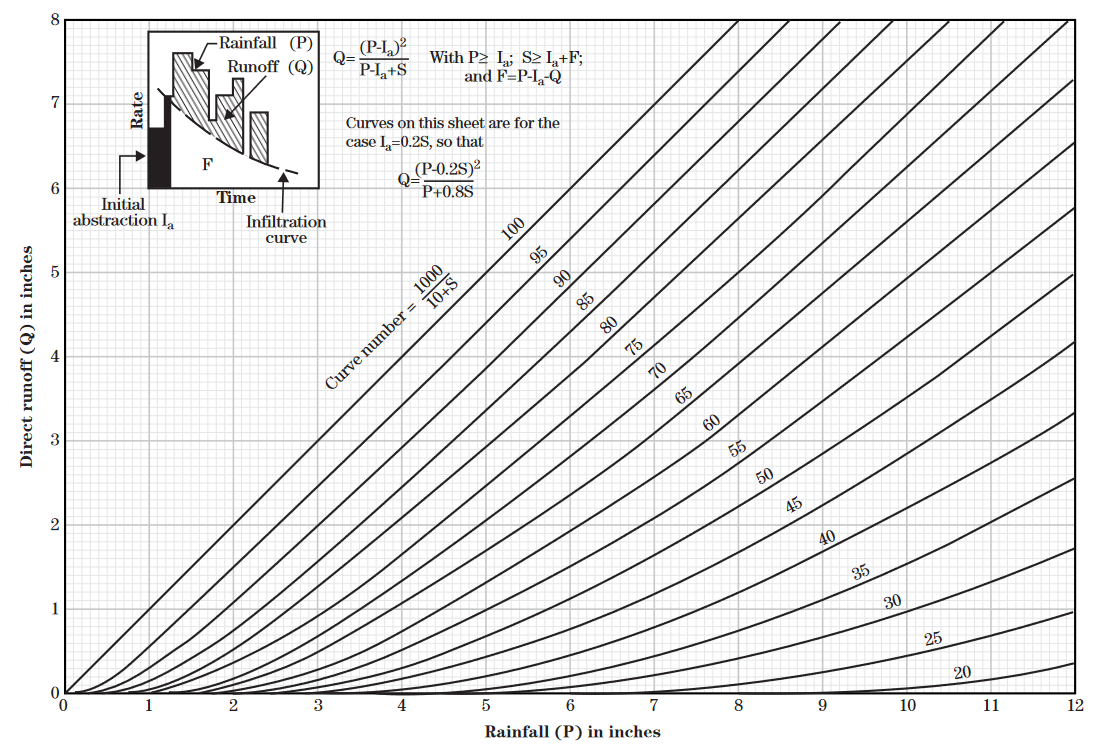
Adjusted Curve Number Calculator
The calculator below can be used to determine the adjusted curve number, with the source spreadsheet available here.